
Day 1: eVTOLs Make History, the Global 8000 Shows Off — and No Boeing in Sight
Day 1 of the Farnborough International Airshow is in the books, and I spent it walking the static park, eating well (more on that below), and watching a flying display that quietly made some history. It’s a noticeably smaller show than Paris last year — you can feel it walking the chalets — but what Day 1 lacked in size it made up for in firsts.
First, the walkthrough
I shot a full walkthrough of the show site so you can see it the way I saw it. More videos are coming all week.
The Airbus static: United’s A321XLR and that Emirates A350

Airbus brought the crowd-pleasers. The star for me was the United A321XLR — one of the first times Airbus’ extended-range narrowbody has appeared at Farnborough, and the airplane that’s about to change how United flies the thinner transatlantic routes. Parked nearby was the Emirates A350-900 (A6-EXY), looking sharp in the sun, plus the A400M and a helicopter rounding out the Airbus corner.
Airbus was a gracious host as usual — breakfast AND lunch. And a shout-out to the media centre, where there were actual breakfast eats this year, sponsored by Embraer. It’s the little things.
History in the flying display: the eVTOLs flew

This is the one people will remember. Vertical Aerospace’s VX4 became the first eVTOL ever to fly a public demonstration at an international airshow — a genuinely nice flight to watch — and BETA Technologies flew its ALIA CX300 as well, making it a dual eVTOL first. The BETA aircraft wore Loganair’s tartan, and there’s a reason: Loganair announced an order for up to 10 ALIA CX300s (5 firm, 5 options) on Day 1.
A hybrid-electric first above 30,000 feet

GE Aerospace used Day 1 to announce that its modified Saab 340B testbed — developed with NASA, BETA Technologies, Boeing’s Aurora Flight Sciences and BAE Systems — has completed the world’s first high-altitude hybrid-electric flight, running its megawatt-class electric+fuel system above 30,000 feet, with the longest flight lasting over two hours. Even better: the airplane is here and flying in the daily displays. I watched it go up on Day 1.
Bombardier’s Global 8000 shows off — twice


Bombardier flew its newest flagship, the Global 8000 — the first time the type has ever flown a public aerial display. And it showed up in style, setting a new city-pair speed record from Los Angeles to Farnborough on the way in. The world’s fastest civil aircraft, living up to the title.
Embraer’s corner
Embraer had a Porter Airlines E195-E2 on the static — always love seeing that livery over here — and the C-390 Millennium muscled through the flying display. Between that and the media centre breakfast, Embraer had a good day.
Freighters and testbeds

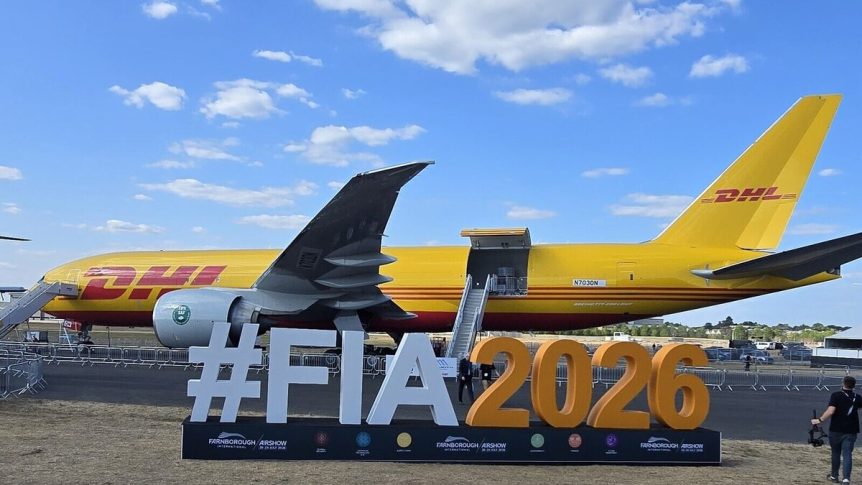
Two of my favorite airplanes on the static: the DHL 777 freighter (N703DN) — a Mammoth Freighters passenger-to-freighter conversion — parked right behind the #FIA2026 sign, and GE Aerospace’s 747-400 Flying Test Bed, the airplane they hang new engines on. A 747 in 2026 is never not worth photographing.
The elephant NOT in the room: Boeing
No Boeing aircraft on display. Qatar Airways pulled out just days before the show, which took the expected hardware with it. The irony? Boeing had a monster Day 1 on paper: SMBC Aviation Capital signed for 100 737 MAX, Philippine Airlines committed to up to 20 787s, and Riyadh Air firmed up 787 options. Airbus answered with 100 A320neo-family jets for SMBC and six more A350-1000s for Riyadh Air, while British Airways made news switching its future A320neo fleet to Pratt & Whitney GTFs. Planes or no planes, the order books were busy.
Closing the show

The UAE’s Fursan Al Emarat aerobatic team closed out the flying display, painting the sky over Hampshire. A perfect end to Day 1.