
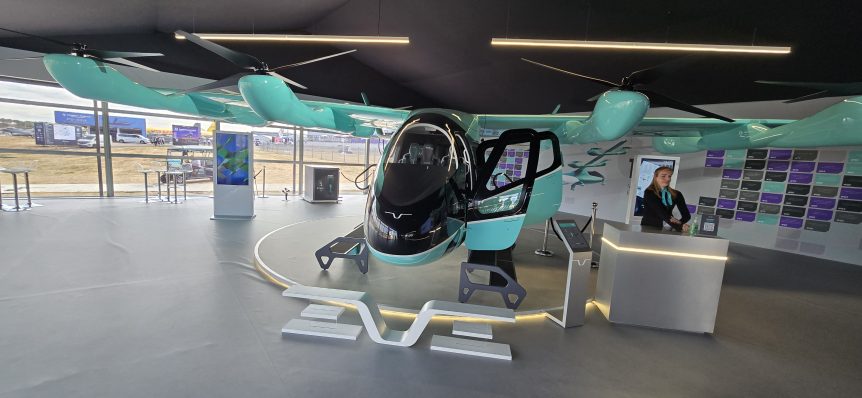
Nine days ago I climbed into a full-scale mockup of Embraer’s electric air taxi on the show floor at Farnborough. Mint green and black, boarding steps down, cockpit door open. I put a plush toy Eve on the dashboard because that is the sort of thing I do.
On Sunday, the real one flew forward for the first time.
Eve Air Mobility announced on August 3 that its engineering prototype completed what the company calls a first partial transition flight — the first time the aircraft’s rear pusher propeller was fired up while it was already in the air. That is a bigger deal than the raw numbers make it sound, and the raw numbers are modest: 27 knots stabilized, 30 knots maximum ground speed, three minutes and nine seconds airborne, 0.84 nautical miles covered, 90 feet above the ground.
Why a three-minute flight matters
Transition is the part of eVTOL flight that keeps engineers awake. Every one of these aircraft has to solve the same problem: it takes off straight up on rotor lift, like a helicopter, and then somewhere over the city it has to stop being a helicopter and start being an airplane, with the wings doing the work instead of the rotors. In between those two states is a window where neither system is fully carrying the aircraft and the aerodynamics get genuinely unpleasant.

Eve’s answer is a lift-plus-cruise layout. Rather than tilting its rotors — the approach Joby and Archer have taken — Eve keeps two separate systems: eight rotors purely for vertical lift, and a single pusher propeller at the back purely for forward thrust. Nothing rotates, nothing changes shape. Fewer moving parts means fewer failure modes, and fewer failure modes means a simpler story to tell a certification authority. The trade-off is that you carry the dead weight of eight lift rotors through the whole cruise.

Sunday’s flight was the first evidence that the handoff between those two systems actually works in the air rather than just in simulation. That’s the milestone. Not the speed.
For context on the pace: this follows 59 previous flights and roughly two hours of total accumulated flight time, with the aircraft topping out around 20 knots as recently as May. Next comes datalink testing to validate radio link performance, then an expanded envelope toward 50 knots, with full transition targeted later this year.
What’s actually inside
This is the part the press release can’t show you, and it’s why I’m glad I made the trip.
The cabin seats four, plus a pilot. Four Recaro seats in teal and black, arranged facing each other — two forward, two aft, knees-to-knees like a train compartment rather than rows like an aircraft. Each one has a multi-point harness, closer to what you’d strap into in a race car than the lap belt you’re used to.

Facing seats are a deliberate choice and a revealing one. It signals that Eve is thinking about these as short, social, taxi-like hops rather than as miniature airline flights. On a twenty-minute ride, sitting across from a stranger is fine. It would be intolerable at two hours. The cabin design tells you the mission.
The cockpit is fully glass. Primary flight displays, digital moving maps, toggle switches on an overhead panel, and a side joystick where a yoke would be. It looks less like a helicopter cockpit and more like a modern business jet that’s been compressed.
And there is a cockpit — with a pilot in it. That matters, because the marketing imagery around this whole sector loves to imply autonomy is imminent. Eve’s own spec sheet lists a future autonomous configuration carrying up to six passengers, but the aircraft entering service carries a human up front. The published range is 100 km — about 60 miles — with cruise speed around 200 km/h, or 125 mph.
The honest caveats
I want to be straight about where this program actually sits, because a lot of the coverage this week has been press-release-shaped.
The aircraft that flew Sunday is an engineering prototype. It is not one of the six conforming prototypes Eve will need to build for the actual certification campaign. Full transition, conforming-aircraft flight testing, regulatory approval and production readiness are all still ahead, and Eve’s certification timeline has already moved once. A 90-foot, three-minute hop is a real engineering result and a long way from a paying passenger.
Eve is publicly traded (NYSE: EVEX, B3: EVEB31), and its announcement carries the standard forward-looking-statement language. Read the milestone as what it is — a test point cleared — not as a delivery date.
What this has to do with the way we actually travel
Here’s the question I keep coming back to, and it’s the one nobody in the eVTOL press cycle is asking: where does this fit into a real trip?
Sixty miles of range is not a replacement for a flight. It’s a replacement for the worst part of a flight — the ground transfer. Think about the transfers you actually dread. Downtown to the airport in traffic. The connection between two airports in the same metro area. The last 40 miles to a resort or a cruise terminal after you’ve already been travelling twelve hours.
If you fly standby, that last category is worth thinking about hard. The single most expensive thing about a non-rev trip isn’t the fare — it’s the flexibility tax you pay everywhere else. You get rolled to a later flight, and suddenly the ground transportation you booked is worthless. An on-demand air taxi with 20-minute hops and no reservation to lose is, in principle, exactly the shape of infrastructure that suits how we travel.
In principle. Pricing will almost certainly launch closer to a helicopter charter than a rideshare, which puts it out of reach for most of us at first. But the infrastructure question is the one to watch: if vertiports get built at airports, they get built for everyone eventually. And when the first ones open, the people who know how to work an airport efficiently will figure out how to use them faster than anybody.
I don’t know when that happens. Sunday’s flight was three minutes long.
But I’ve sat in the cabin, and it exists, and last weekend it flew forward for the first time. That’s further along than it was a month ago.
Have you seen an eVTOL up close? Tell me in the comments what you’d want to know about the cabin — I have more photos and video from Farnborough than I could fit here.